
Lenovo Legion Y700 AI: Snapdragon 8 Elite Gen 5 CPU, 8.4-inch 165Hz OLED, 7,470mAh battery

Lenovo outs yet another gaming tablet, the Lenovo Legion Y700 AI. The Lenovo Legion Y700 AI features a compact but fast and colorful display. It’s an 8.4-inch OLED screen with a 2.5K resolution, 12-bit color, and Dolby Vision. There’s a high 165Hz refresh rate and an impressive 4,000-nit peak brightness. Powering the device is an apt Qualcomm Snapdragon 8 Elite Gen 5 processor, with up to a whopping 24GB of RAM and up to 1TB of storage that you can expand further by up to 2TB via the microSD card slot. This machine uses LPDDR5T RAM and UFS 4.1 Pro storage. The chipset is attached to a large 15,000mm2 cooling system. It also boasts two USB-C ports, one is a USB 3.2 Gen 2 that supports DisplayPort, while the other is only USB 2.0 for data and charging. A 3.5mm headphone jack is also here. Also here are the latest WiFi 7 connectivity, Bluetooth 5.4, a decent 7,470mAh battery, and 68W fast charging. The Lenovo Legion Y700 AI is now available...
Android, iOS, or HarmonyOS: Which mobile OS led the market in Q2 2026

Android-iOS-Harmony

The mobile market is dominated by three major operating systems: Google’s Android, Apple’s iOS, and HUAWEI’s HarmonyOS.

Being part of any of these ecosystems can feel almost like a religion to some people, with hardcore fans who swear by their choice of operating system. So, if you’re curious about how each platform performed in terms of market share, Counterpoint Research has the answer.
Android-iOS-Harmony-Q2-2026-Global

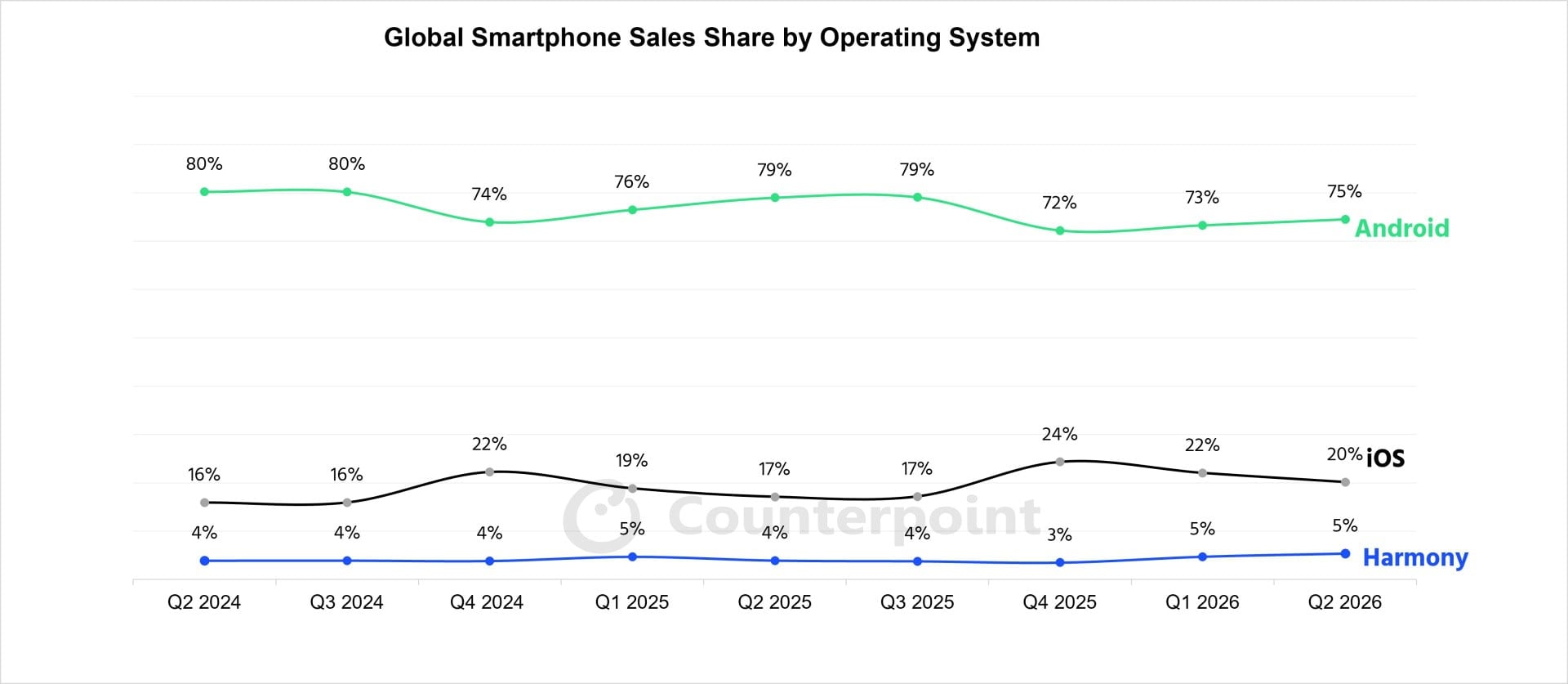
In terms of global smartphone sales, Android dominated Q2 2026 with a 73% market share, maintaining a huge lead over its competitors. That’s up from 72% in the previous quarter.

iOS came in second with 20%, despite a 2% drop from the previous quarter, while HarmonyOS took third place with a 5% market share.
Android-iOS-Harmony-Q2-2026-US

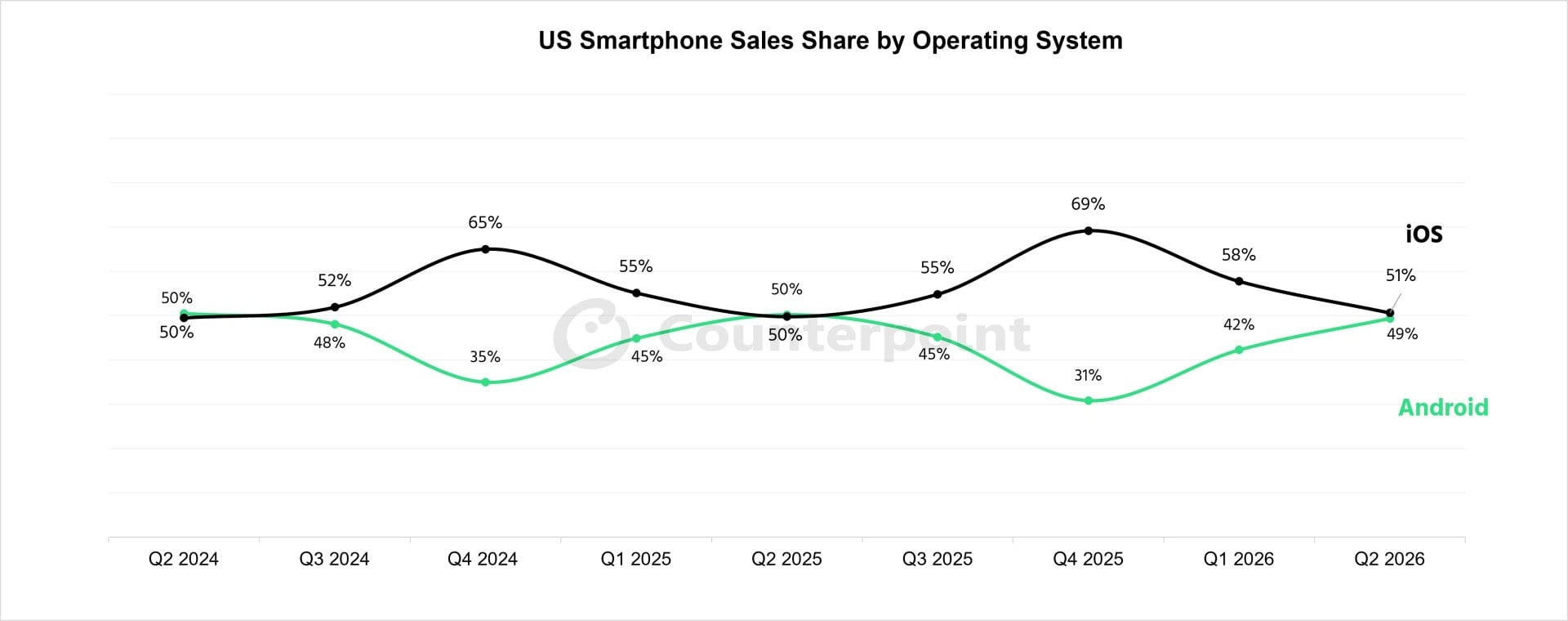
iOS continues to dominate its home market, the United States, with a 51% market share. However, we’re seeing a trend where Android manages to close the gap, only to fall behind again. In Q2 2026, Android narrowed the gap to just 2 percentage points, reaching a 49% market share.

HarmonyOS is not included in the US figures, as HUAWEI mobile devices are banned in the country.
Android-iOS-Harmony-Q2-2026-India

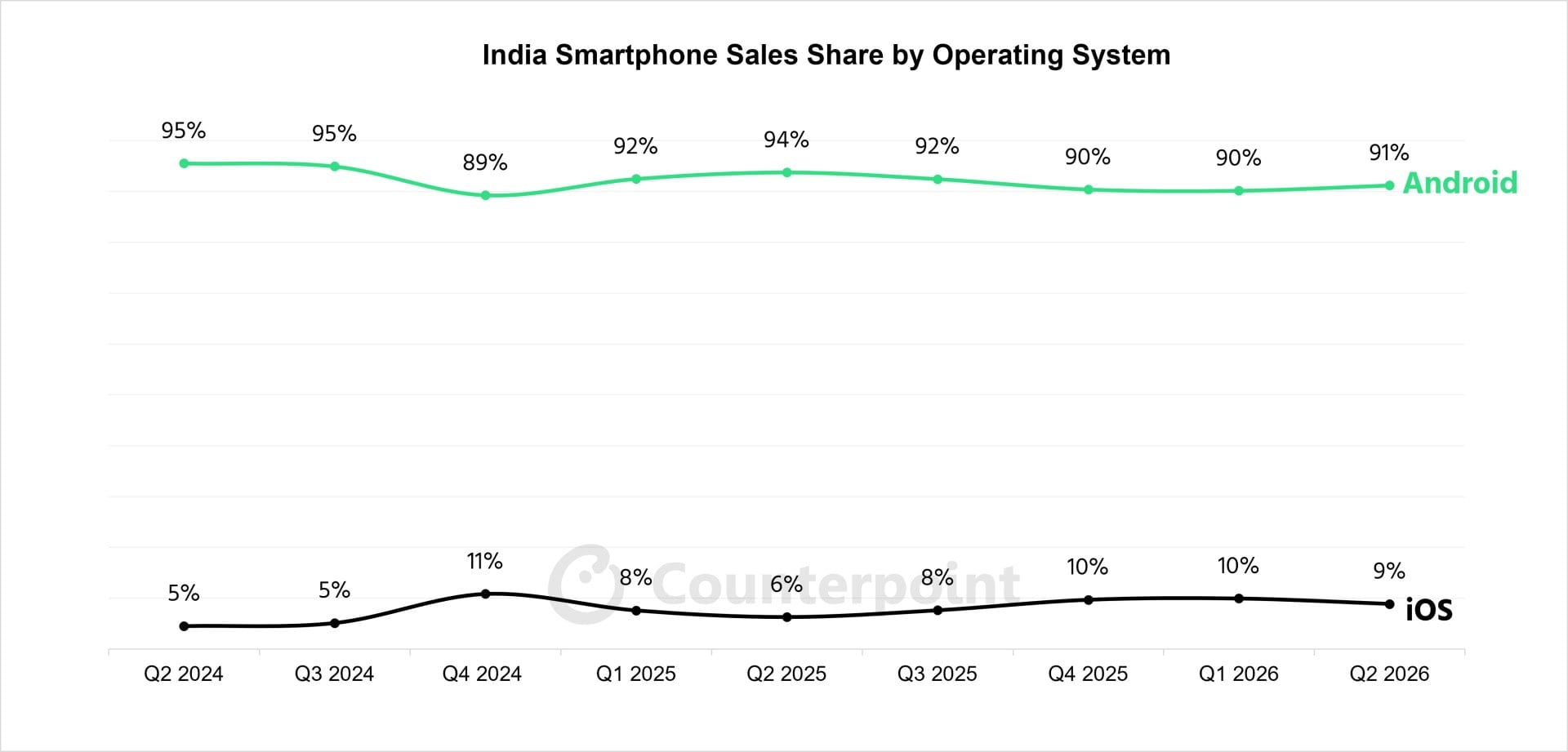
Another market where HUAWEI devices are unavailable is India. The country is heavily dominated by Android, which holds a whopping 91% market share. iOS continues to struggle to gain a foothold, with just 9%.
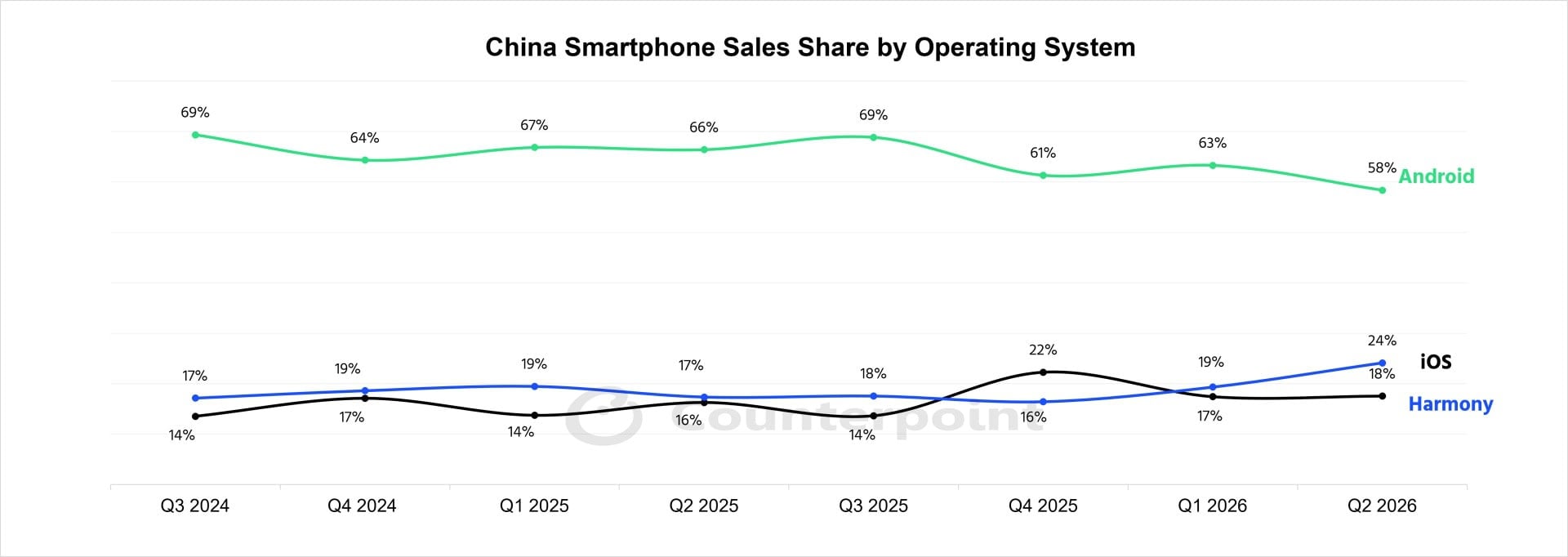
Android-iOS-Harmony-Q2-2026-China

You’d think HarmonyOS would dominate its home market of China, but the numbers tell a different story. While it managed to overtake iOS in Q4 2025, HarmonyOS fell behind again in Q2 2026, holding an 18% market share compared to Apple’s 24%.

Android continues to dominate China with a 58% market share.

Counterpoint Research also noted that the global smartphone market suffered an 11% decline in shipments compared with the same quarter last year, with the entry-level and mid-range segments suffering the most.

This article, Android, iOS, or HarmonyOS: Which mobile OS led the market in Q2 2026, was originally published at NoypiGeeks | Philippines Technology News, Reviews and How to's.


Comments

Popular posts from this blog

OPPO Reno15 Review

The OPPO Reno15 series comes in threes, and if you’re not sure which one to get, check out our Reno15 review to see if this is the one you should get, or the one you should rule out. If you didn’t know already, the OPPO Reno15 sits between the fancier Reno15 Pro , which retails for Php49,999, and the Reno15 F, priced at Php25,999. With an SRP of Php36,999, is the OPPO Reno15 5G the right one for you? Let’s find out. OPPO Reno15 5G Global Specs Android 16, ColorOS 16 Dual SIM, Dual Standby 6.59-inch 1.5K LTPO AMOLED display, 2760 x 1256 pixel resolution, ~460ppi 120Hz refresh rate, Corning Gorilla Glass 7i 3840Hz PWM dimming, 1,200-nit peak brightness 2.8GHz Qualcomm Snapdragon 7 Gen 4 octa-core processor Adreno 722 GPU 12GB RAM 256GB/512GB UFS 3.1 internal storage, non-expandable 50-megapixel front camera 50-megapixel (f/1.8, PDAF, OIS) + 50-megapixel (f/2.8, OIS, 3.5x telephoto) + 8-megapixel (f/2.0, ultra-w...

Amazon announces two new Tomb Raider games

Get ready to dust off your climbing axes. Lara Croft, the legendary treasure hunter, is returning to consoles and computers in a big way. Following a long break from solo adventures, two major new games in the Tomb Raider series were revealed at The Game Awards 2025. The last time players controlled Lara in a core series game was 2018’s Shadow of the Tomb Raider. Now, publisher Amazon Games and longtime developer Crystal Dynamics are bringing her back with a pair of distinct projects. The first is Tomb Raider: Legacy of Atlantis , a full remake of the original 1996 game that started it all. It is being built with Unreal Engine 5 by Crystal Dynamics and Flying Wild Hog. Fans can expect a visual overhaul for Lara’s first journey, which the announcement suggests will still include prehistoric creatures. This remake is planned for launch in 2026 on PlayStation 5, Xbox Series X/S, and PC. Following that will be Tomb Raider: Catalyst , an entirely new story set for release in 2027....

Sei Crypto Wallet to come pre-installed on Xiaomi phones

Xiaomi and The Sei Development Foundation, a non-profit that promotes the Sei network, have entered a global partnership that aims to promote mainstream blockchain adoption. From 2026, Xiaomi phones available outside mainland China and the United States will come pre-installed with a wallet and crypto discovery app developed by Sei Labs. This would definitely help increase the adoption of the network as Xiaomi is one of the biggest smartphone vendors in the world, just behind Samsung and Apple. Participating phones will be able to conduct peer-to-peer payments, explore Web3 products, and access decentralized applications without the need to download third-party apps. What’s more, Sei plans to implement stablecoin payments in over 20,000 Xiaomi stores, starting in Hong Kong and the European Union. Sei Labs aims to “build a decentralized NASDAQ” and targets to accommodate 200,000 transactions per second as it aims to shift the financial ecosystem on-chain. To make it possible, th...